
English| USD
Suggested for you
More currencies
Choose a language
Telegraph Cove is a boardwalk village of a few dozen buildings set on pilings above Johnstone Strait, and nearly every visitor arrives with the same scheduling question. Departure lengths differ by operator, vessel and how far crews range in search of orcas and humpbacks. This guide explains what sets that length, and how to fit a sailing into a single day on northern Vancouver Island.
Quick answer
Whale watching departures from Telegraph Cove are scheduled inside the village's daily 08:00–20:00 window, and each sailing occupies a block of hours rather than minutes. Exact run times vary by operator, vessel type and how far crews travel into Johnstone Strait. Check-in works most smoothly between 09:00 and 17:00; confirm the length of your specific departure on its booking page before driving out.
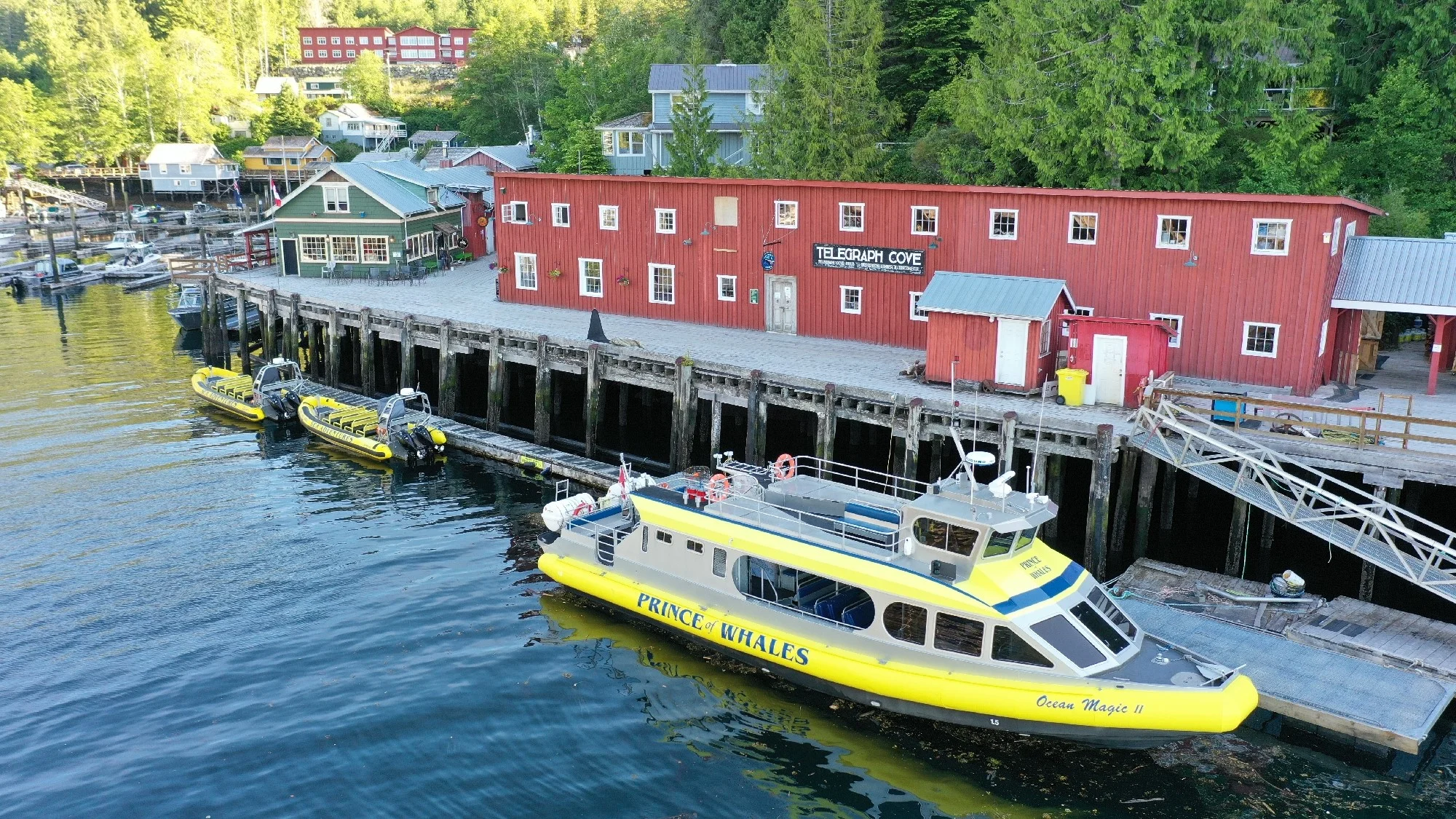
Roughly 20 kilometres south-east of the boardwalk, the northern resident orcas of Johnstone Strait do something no other killer whales are known to do: they rub their bodies against the smooth pebble beaches of Robson Bight. The bight has been a protected ecological reserve since 1982, and vessels are kept out of it entirely. Visitors regularly ask how long are whale watching tours from Telegraph Cove, and the honest answer starts with that boundary drawn across open water. Time on the water here is a function of distance. Telegraph Cove sits at the narrow northern end of Vancouver Island, where Johnstone Strait, Weynton Passage and Blackfish Sound funnel migrating salmon past a shoreline of second-growth cedar. Boats leave the harbour and travel outward until wildlife appears, then hold position at a legal distance. One morning sailing may find humpback whales lunge-feeding within sight of the cove. Another crew may run toward the Broughton Archipelago before a single blow is spotted. Vessel type matters as much as luck. Rigid-hull inflatables cover ground quickly and sit low to the surface, while covered cruisers move at an easier pace and carry a heated cabin, a naturalist and a hydrophone for listening to resident pods. The same channels support fast orca watching excursions and slower Vancouver Island wildlife cruises alike. Steller sea lions, Dall's porpoise and bald eagles fill the intervals between sightings. For planning purposes, a sailing is best treated as a committed block of the day rather than an errand squeezed between other stops. Each operator publishes the scheduled length of its Telegraph Cove whale watching trip on the departure page, and that stated figure — not a general rule of thumb — is the one worth building a day around. Weather supplies the variables. Wind funnelling through the strait can push back a launch. A lingering pod can stretch a return leg. Crews working from the cove's boardwalk plan around daylight, and the village keeps its own longer schedule for anyone waiting on a later departure. Read the run time on the booking page, add a buffer at both ends, and the question of how long are whale watching tours becomes a straightforward calendar decision rather than a guess.
“Time on the water here is a function of distance.”
This plan suits first-time visitors booking a standard Telegraph Cove whale watching departure, which typically runs 3 to 4 hours on the water. Allow about 5 to 6 hours in total once check-in and time in the village are counted.
Leave the car in the lot above the village and walk down to the boardwalk, roughly five minutes on foot with a short, steep grade.
Report to the tour office on the boardwalk at 24 Boardwalk to confirm your booking and collect a life jacket. Check-in usually closes 30 minutes before departure, so build in a buffer for the queue.
Boarding takes 10 to 15 minutes as crew load passengers from the dock. Add a warm layer now; it is consistently colder on Johnstone Strait than on shore.
The tour itself runs 3 to 4 hours searching for orca, humpbacks and other wildlife. Duration varies with sightings and sea conditions, and crews rarely cut a good encounter short.
Disembarking and gathering gear takes another 10 minutes. Times are approximate, so avoid booking a ferry or onward drive too tightly after your slot.
The centre on the boardwalk holds articulated skeletons of whales and other marine mammals; allow 45 minutes.
Walk the length of the historic boardwalk past the restored heritage buildings, then stop for a drink before leaving. Around an hour is enough.
The best arrival window for whale watching tours is 09:00–17:00, which provides optimal daylight for wildlife visibility and aligns with standard tour check-in procedures. Planning your visit within these hours maximizes your opportunity to experience the marine environment while light conditions are most favorable.
Warm, 15°C to 22°C; stable seas
Orca sightings are most frequent as salmon runs begin. Expect busier docks and require advance planning.
Cool, 10°C to 18°C; variable conditions
Wildlife remains active, and the reduced visitor volume offers a quieter experience. Early and late season can see cooler marine temperatures.
Optimal daylight for observation
Arrivals between 09:00 and 17:00 ensure proximity to tour departures. Consistent daylight hours support better spotting conditions across all tour types.
Verdict: The optimal time to visit is during the peak summer months of July and August, arriving between 09:00 and 17:00 for the best balance of wildlife activity and daylight.
Telegraph Cove is located on the northeastern coast of Vancouver Island. The most direct approach is by vehicle via Highway 19, which provides access to the remote northern end of the island.
Highway 19 to Telegraph Cove Road
Highway 19 to Telegraph Cove Road
Highway 19 to Telegraph Cove Road
Upon reaching Telegraph Cove Road, follow the signs leading to the village entrance. Parking is available near the village area, allowing for easy access to the Boardwalk at 24 Boardwalk.
Access to Telegraph Cove village is free for all visitors. Please note that whale watching tours are independent commercial operations and are priced separately from village entry.
Verdict: There is no entrance fee to the village, though individual whale watching tour rates vary based on the specific operator and trip selection.
Telegraph Cove maintains consistent daily operating hours to assist with your tour check-in planning. The facility is open seven days a week throughout the season.
Work through these steps in order, from booking weeks ahead to the final checks before you step onto the dock at 24 Boardwalk.
Everything you need to know about how long are whale watching tours
Most whale watching tours departing from the village typically last 3 hours. Some specialized excursions may extend to 3.5 hours depending on wildlife activity and travel distance within the Johnstone Strait. Each Telegraph Cove whale watching tour is guided by a professional naturalist who provides insights into local marine ecosystems. Exploring the local waters for this amount of time offers the best balance for wildlife observation while keeping the schedule manageable. Participants in a typical Telegraph Cove marine wildlife tour should expect a total experience of approximately 3 hours on the water. This duration allows for significant travel through prime habitat for orcas, humpback whales, and other local species. These coastal adventures are often considered family-friendly, though age requirements may vary by vessel type. Zodiac-style boats often have specific physical requirements such as minimum height or age, while covered cruisers may offer a more stable environment for younger travelers. It is essential to review the specific health and safety restrictions provided by the operator before booking. You must check in at least 30 minutes before your scheduled departure time at the adventure center. Arriving early ensures that you have enough time to complete necessary waivers and receive a safety orientation. Late arrivals may result in missing the boat, as departures are strictly scheduled. Many local operators offer a whale sighting guarantee. If you do not see a whale during your trip, you are often entitled to join a future tour on a standby basis until a successful sighting occurs. Be sure to clarify the terms of this guarantee with your specific tour provider. Most vessel-based tours in the area are unfortunately not wheelchair accessible due to the nature of boat boarding and the marine environment. Visitors with limited mobility or other accessibility needs should contact operators directly to discuss specific requirements. The docks and village boardwalks may also present challenges for those with mobility impairments.